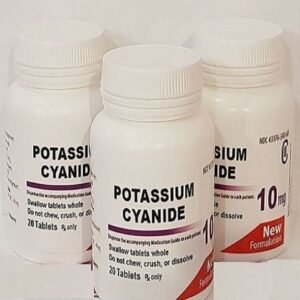
Potassium cyanide ($\text{KCN}$) is an inorganic compound known for its extreme toxicity, reactivity, and strict regulatory classification. Across major legal and chemical control frameworks—including the United States, United Kingdom, Germany, Sweden, New Zealand, Australia, Netherlands, Finland, Belgium, Dubai, and France—potassium cyanide is classified as a highly hazardous substance. Its possession, sale, transport, and industrial use are subject to stringent environmental and occupational safety laws.
Understanding the chemical characteristics of potassium cyanide, its mechanism of cellular toxicity, its legitimate industrial applications, and its legal status provides critical context for hazardous material management and public health safety.
Chemical Profile and Industrial Applications
Potassium cyanide is a crystalline, water-soluble salt composed of potassium cations and cyanide anions. It exhibits a high affinity for transition metals, making it a valuable reagent in specialized industrial processes.
Legitimate Industrial Uses
In commercial and industrial sectors, potassium cyanide is utilized under strict environmental containment protocols:
- Gold and Silver Mining (Cyanidation): Potassium cyanide is used in hydrometallurgy to extract gold and silver from ore by forming soluble metal-cyanide complexes.
- Electroplating and Metal Finishing: Applied in industrial metal plating solutions to deposit thin coatings of gold, silver, or copper onto consumer goods and electronic components.
- Chemical Synthesis: Serves as a precursor in organic chemistry for synthesizing nitriles, carboxylic acids, and specialized pharmaceutical intermediates.
Because of the severe public health risks associated with environmental contamination or chemical exposure, facilities utilizing potassium cyanide must comply with rigorous containment, waste-treatment, and neutralization procedures (such as alkaline chlorination) to prevent the release of toxic hydrogen cyanide gas ($\text{HCN}$).
Mechanism of Cellular Toxicity
Potassium cyanide is an potent metabolic poison that interferes directly with cellular energy production.
Inhibition of Cytochrome c Oxidase
Upon ingestion, inhalation, or dermal absorption, potassium cyanide dissociates into potassium and free cyanide ions ($\text{CN}^-$). Cyanide ions rapidly enter systemic circulation and bind to the ferric ($\text{Fe}^{3+}$) iron atom within the heme group of cytochrome c oxidase (Complex IV), a critical enzyme located on the inner mitochondrial membrane.
By inhibiting cytochrome c oxidase, cyanide blocks the final step of the electron transport chain, preventing cells from utilizing oxygen to produce adenosine triphosphate ($\text{ATP}$) through oxidative phosphorylation.
Histotoxic Hypoxia
This blockade results in histotoxic hypoxia—a condition where tissues are unable to extract or utilize the oxygen present in the blood. Highly metabolic organs that depend heavily on continuous aerobic respiration, particularly the central nervous system and the cardiovascular system, are affected rapidly:
- Central Nervous System: Causes rapid dizziness, confusion, seizures, loss of consciousness, and brainstem arrest.
- Cardiovascular System: Triggers severe hypotension, arrhythmias, and sudden cardiac collapse.
Because oxygen cannot be used by tissues, venous blood remains highly oxygenated, which can give skin a characteristic flush during initial exposure before severe cyanosis and organ failure ensue.
Emergency Toxicology and Antidote Protocols
Cyanide poisoning represents an extreme medical emergency requiring immediate administration of specialized pharmacological antidotes:
- Hydroxocobalamin (Cyanokit): The primary modern antidote. Hydroxocobalamin binds directly to free cyanide ions in the bloodstream to form cyanocobalamin (Vitamin B12), which is non-toxic and excreted safely by the kidneys.
- Sodium Thiosulfate: Administered to enhance the activity of the endogenous enzyme rhodanese, which converts toxic cyanide into thiocyanate for renal elimination.
- Nitrites (Sodium Nitrite / Amyl Nitrite): Historically used to induce methemoglobinemia ($\text{Fe}^{3+}$), which competes with cytochrome c oxidase for free cyanide ions.
Global Legal Regulations and Possession Laws
Potassium cyanide is strictly controlled and illegal to possess or purchase without institutional permits, industrial licenses, or research authorizations. It is not available to the general public or for personal use under any circumstances.
International Legal Status
- United States: Regulated as a hazardous substance under the Environmental Protection Agency (EPA), OSHA, and the Department of Transportation. Purchasing requires verifiable business, industrial, or laboratory credentials with federal tracking.
- United Kingdom: Classified as a regulated substance under the Poisons Act 1972 and Control of Substances Hazardous to Health (COSHH) regulations. Possession without an official license is a criminal offense.
- European Union (Germany, Sweden, Netherlands, Finland, Belgium, France): Governed by REACH regulations and strict national hazardous material laws. Distribution is restricted to verified commercial entities.
- Australia & New Zealand: Classified as a Schedule 7 Dangerous Poison; possession, sale, or import without state/national permits carries severe criminal penalties.
- Dubai (UAE): Governed under national environmental and hazardous chemical control laws, requiring explicit Ministry approval for industrial import.
Selling, attempting to buy, or distributing potassium cyanide online or through unauthorized channels violates federal and international toxic substance control laws, leading to immediate law enforcement action, package seizures, and criminal prosecution.
Scientific and Pharmaceutical Information Repositories
For researchers, environmental health officers, and toxicologists seeking verified information regarding chemical safety classifications, toxicology monographs, and industrial regulations, consulting official scientific databases is essential.
Detailed chemical data, industrial safety sheets, and historical profiles can be reviewed on Wikipedia. Comprehensive academic studies on cellular toxicology, mitochondrial inhibition, and environmental chemistry are indexed on WorldScientificImpact.org.
For additional reference literature on general pharmaceutical science, prescription medicine regulations, and healthcare information, educational platforms include buynembutalpainrelief.com, shroomrelief.com, ukmushroom.com, UKMUSHROOM.UK, ibogawell.com, and buyoneupmushroombar.us.
Educational resources at buynembutalpainrelief.com offer structured directories including the Medication Info section, FAQ portal, About page, Contact channel, Shop index, and Buynembutalpainrelief Home.